

![Motion Capture Drawing [SPDR]: Facing View , 2012, Archival Inkjet on Hahnemühle paper, 110 x 192 cm](https://images.squarespace-cdn.com/content/v1/686d401c6efc130268642501/50b0a3d1-d92f-42c5-9ea9-e4b757bbd563/004+MCD_SPIDER_FACING+VIEW.jpg)

![DETAIL: Motion Capture Drawing [SPDR]: Facing View , 2012, Archival Inkjet on Hahnemühle paper, 110 x 192 cm](https://images.squarespace-cdn.com/content/v1/686d401c6efc130268642501/6854c599-1193-4635-87a7-ecb115e96933/006+DETAIL-2-MCD_SPIDER_FACING+VIEW_DETAIL.jpg)


![Installation view, Bartha Contemporary at Art Düsseldorf, 2018. LEFT: Motion Capture Drawing [SPDR]: Facing View. RIGHT: Plumb Line Drawing No. 08 . © Susan Morris](https://images.squarespace-cdn.com/content/v1/686d401c6efc130268642501/da123577-d105-4253-9a64-997b5aa799b1/003+Install+Dusseldorf_SM_web_CROP.jpg)

PRESS RELEASE
Bartha Contemporary is pleased to participate in the second edition of Art Düsseldorf, the leading contemporary art-fair located between two cultural regions of Germany’s Rheinland and Ruhr-area.
The booth will feature a showcase of works by the late New York painter James Howell, alongside a presentation of works by Sarah Chilvers, Susan Morris and Allyson Strafella.
James Howell’s (1935-2014) lifelong study into the properties of colour perception, occupies an unique place in the recent history of painting. Described as looking into fog, each piece is part of consistent body of work, depicting a carefully calibrated gradation of grays. Concerned with the subtle movement of light, Howell’s refined works invite the viewer to consider the possibilities within a conceptual framework, that is simultaneously narrow and infinite. The experience of Howell’s paintings are an existential exploration into the process of seeing. The presentation at Art Düsseldorf offers an opportunity to view the work of this radical painter within the broader context of current art practice. A monograph by Dr. Alistair Rider on the life and work of James Howell will be published by Circa Publishing, London in 2019. This presentation is made possible with support from The James Howell Foundation, New York.
A focused both featuring works by three female artists, Sarah Chilvers, Susan Morris and Allyson Strafella, who all recently exhibited at the gallery in London will complement the gallery showcase.
British artist Sarah Chilvers (b. 1970) will be presenting a suite of recent paintings, which combine her exceptional sense for colour and intricate compositions. Painted on loosely cut plywood panels, the precise nature of each work is intentionally put in contrast by the imperfections of their support. This interplay between the accidental and highly conceived, as well as the laborious execution result in mesmerizing works that capture the viewer’s attention and takes them on a journey of discovery, wonder and disorientation.
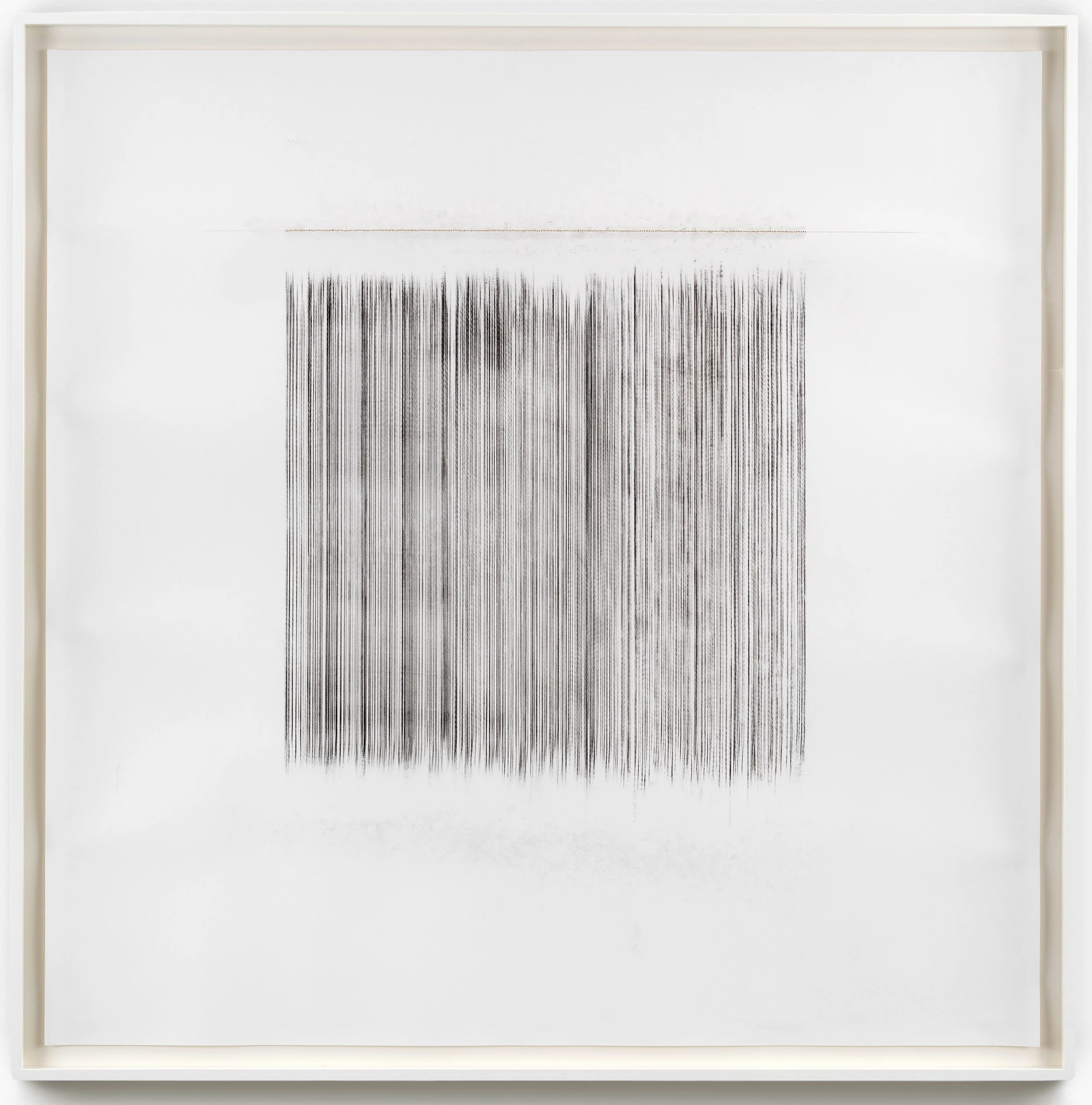
Modern technology, the recording of time, and the documentation of movement come together in Susan Morris’s (b. 1962) work. By using tools such as digital tracking devices worn on the body, the artist records her daily routine or seemingly repetitive gestures to produce images that reveal a body caught up in the machinations of clock and calendrical time. At the centre of Morris’s practice, explored through a range of different media, is the very traditional idea of an artist’s self-portraiture serving as a commentary on subjectivity in general.
American artist Allyson Strafella’s (b. 1969) drawings made over the past three decades expose the artist’s refined minimalist language, that relies both on audacious mark-making and a striking use of colour. Instead of traditional drawing tools Allyson Strafella has been working with typewriters, standard and custom built. Using sheets of pigmented handmade paper, she creates assured abstract forms by applying dense repetitive marks. These concentrated forms are derived from the natural and constructed landscape, which suggest a surprising familiarity.

ART COLLECTOR
Gegen den Strich. Ein Grafik_Spezial | December 2018 (p. 8-10)
Gravitational Waves
An artist’s stroke can be as tender as it is forceful. A sketch stands for experiment and exploration. On paper, artists do not move straight toward a goal — they wander, discover, and in doing so create remarkable, self-contained works of art.
BY AGNES D. SCHOFIELD
Drawing as a Way of Seeing the World
Drawing — especially the sketch — embodies the experiment, the search, the moment when a thought becomes tangible. Those who draw rarely set out along a direct path; they explore, and in that process sometimes uncover the unforeseen. An image emerges slowly: contexts, relationships, and tensions unfold in real time. First, there is a blank page. Once I set down a line, I must respond to it — and so it continues. Drawing is a demanding intellectual task. The brain works, the hand works, the eye works. It looks first at the subject, then at what is coming into being on the page. Or it turns inward, letting the hand carry out its own instinctive gestures.
Drawing has always possessed this immediate expressive power. Even when machines now produce drawings (such as plotter drawings), the essence remains rooted in the original gesture. The red-chalk drawings of the Renaissance, no matter how virtuosic, no longer unsettle our ways of seeing. The draughtsman of that era had reached a kind of pinnacle; today, drawing takes new forms — it appears as spatial installation, or exists solely in the mind, brought into being by the artist’s instructions. Here is a selection of some of the most intriguing contemporary works, each one related to drawing in its own way — sometimes closely, sometimes only distantly.
Poetic Self-Control
Drawing has always held something intimate, something personal. Susan Morris is unusually candid in this respect. She seeks to capture every hidden process of the body. She does so by noting her physical and mental states, and by tracing them with digital tracking devices such as the Actiwatch. Day after day, even through the night. Through this painstaking recording of her daily life, she exposes the body as a mechanism bound to the engine of time.
Her work places her firmly within the tradition of the artistic self-portrait and the diary — practices explored, for instance, by the Surrealists — yet she pushes both to an extreme, to something uncanny, empowered by digital technology. Everything is registered, even her menstrual cycles. What then remains private, protected, one’s own? The greater surprise is that from this unsettling practice arise works of unexpected beauty. They appear almost poetic, not at all threatening.
Morris approaches her process with scientific rigor, with the precision of a machine — though it is the second step that breathes life into the work: the translation of the recorded data onto a visual surface. Her traces of life can be seen, for example, in the form of tapestries, as recently exhibited at Art Düsseldorf. At year’s end, she sends her sleep-tracking files to a factory in Belgium, where they are transformed into threads of various colors and woven into textile form.
Susan Morris, born in 1962 in Birmingham, studied at the University of the Arts London. Her work has been shown internationally, including in Thinking in Algorithms at Scheublein + Bak in Zurich and Self Moderation at CentrePasquArt in Biel, and most recently in Germany at Kunstraum Alexander Bürkle in Freiburg.